Showing posts with label book review. Show all posts

Monday, November 23, 2009

SOAR, Saturday

Wow, I've really gotten behind.  Sorry, guys!  Life has been getting in the way and I keep putting my notes in a "safe" place aka somewhere under all sorts of stuff. 

Saturday, October 31 (Halloween!), tasks for the day: 2 retreat sessions, marketplace (I know, I know), and spin-in party

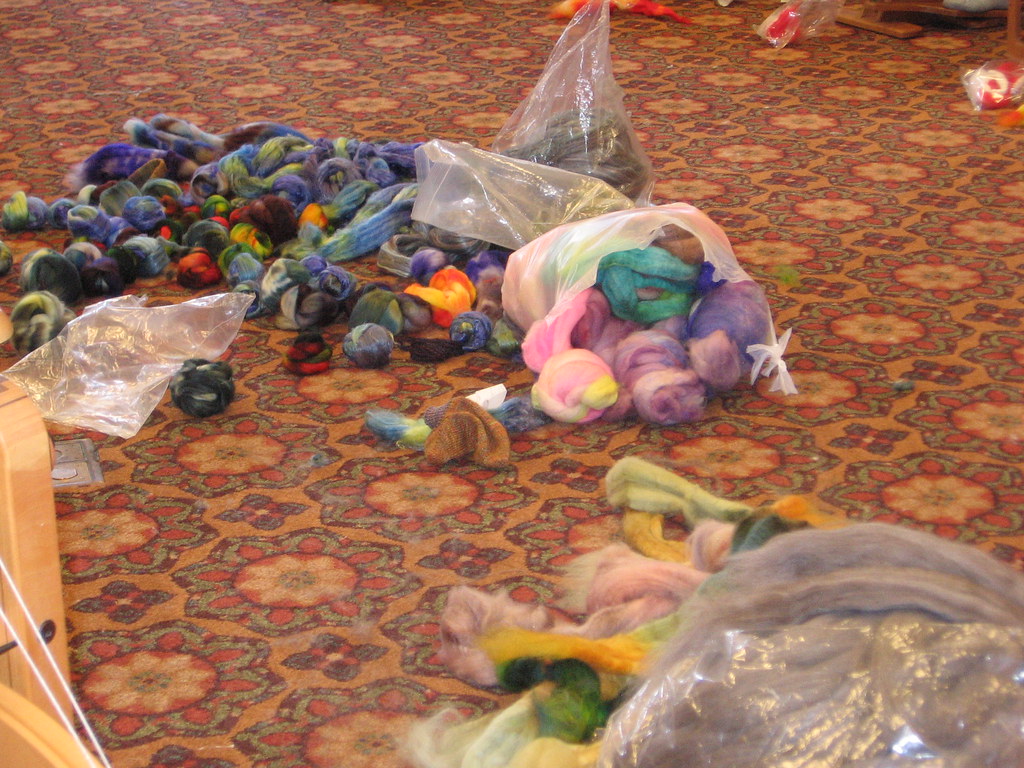
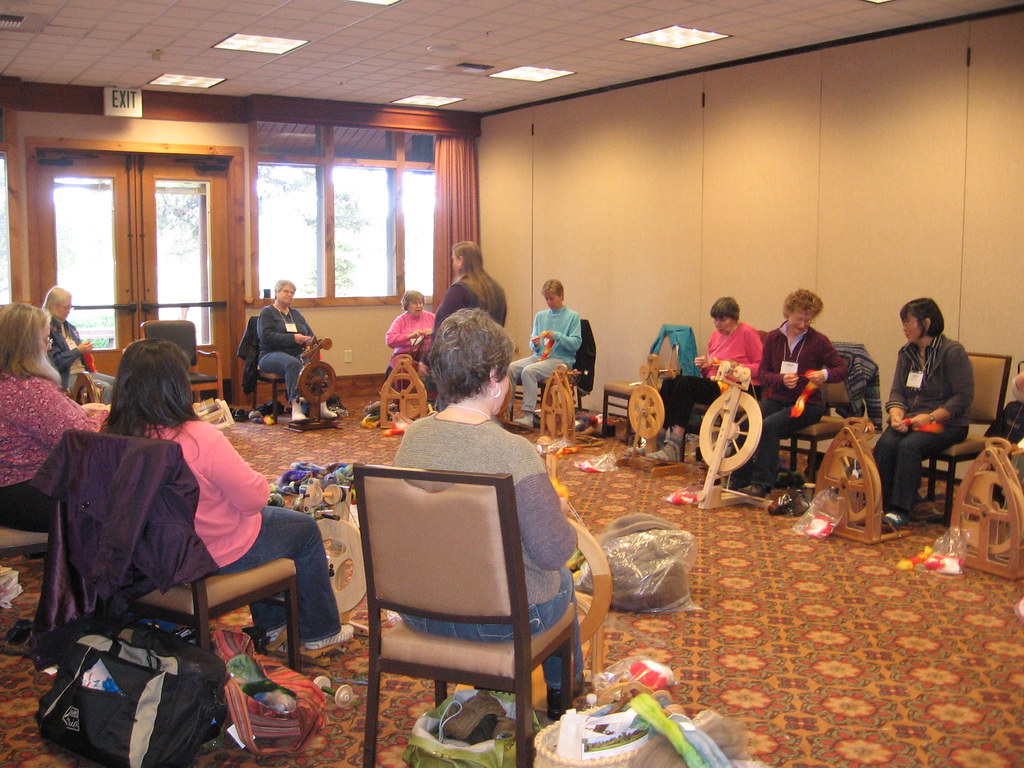
Happy Halloween!  On Saturday, I once again got up super early (surprise, surprise!) and went off to breakfast.  From there I moved on to my sock class.  I love knitting socks so taking a class on spinning for them made perfect sense!  The class was appropriately called Spinning for Socks and was taught by Janel Laidman.    Many of us arrived early and got our wheels set up.  We were greeted by a wonderful sight in the middle of the room.  


I decided that I would set my wheel up for plying only and spin my singles on my various drop spindles.  See, this is the advantage of having *cough* many drop spindles.  When we got ready for plying, I wound my singles off onto a paper tube or left them on the spindle and put them in empty water glasses so they wouldn't go spinning across the room.  Mostly my system worked well except when the paper tube flew out and would bounce all around under my chair. 

Janel had everyone go around the room and say who they were, where we were from and how long we've been spinning.  It was so interesting to hear about the different ladies' stories.  Some of them had been coming to SOAR since the very first one!  It was neat to hear how spinning has changed since they first started spinning.  They recounted stories about being snowed in and other craziness.  Times like that were my favorite part of SOAR.  Talking with people and listening to their stories was just so interesting! 


Janel recommended BFL for its softness and durability.  Most of the fibers we used in the class were BFL, actually.  She recommended, if you are using a fine wool, blend it with something like nylon, tencel or bamboo to make the fine wool stronger.  To get a strong, dense yarn, you should use a worsted spinning technique.  Woolen spinning would give you a lofty, warm yarn but it wouldn't be as durable.  Janel also recommended using 3 or more plies for your sock yarn.  Her reason for this is, with more plies, more surface area is hidden within the yarn.  With more surface area hidden, there is less chance for the yarn to abrade and make holes.  It also makes the yarn stronger the more plies there are.  My "lovely" picture shows a 3-ply yarn and those itsy-bitsy red scrawls are the parts of the surface area hidden by the ply.  (Hey, it's really hard to draw on Google docs with your mouse!)


Janel recommended having a twist angle of 45 degrees for sock yarn.  Now, I'm not that technical of a spinner.  If you are interested in learning more about twist angel, she told us to check out the Essentials of Yarn Design by Mabel Ross.  It has a diagram in it that helps you figure out what twist angle you have put into your yarn.  We also talked about twists per inch, another way of describing twist angle.  Janel had us spin our singles in different colors so we could easily see how many twists we have per inch.  They definitely had a barber pole effect!  Twists per inch helped us a lot in our plying. 

For plying, Janel told us a simple formula. 

For a 2 ply, you want your ply twists to equal 2/3 of your spin twists per inch. 
For a 3 ply, you want your ply twists to equal 3/4 of your spin twists per inch. 
For a 4 ply, you want your ply twists to equal 4/5 of your spin twists per inch. 


In other words, the more plies you have, the more twists per inch you should have.  One liberating thing Janel told us is that your plied yarn doesn't have to hang perfectly straight (i.e. a perfectly balanced yarn) to make a good sock yarn.  As long as your yarn is finished correctly (washed and dried without a weight hanging on it), your twist will be set.  If you want a yarn that is lofty and soft, she recommened using fewer plies.  But if you want a hard wearing and strong yarn, you should err on the side of caution and put in more plying twists per inch.  In fact, she said you can sometimes go up to 1 1/2 times the spinning twist.  I always have felt like I put too much twist in but that is apparently not the case!  It was easy to see with all of the different colors of the singles.  One of mine was red, another brown, the third an orange/yellow, and the 4th a yellow/green.  It was definitely an interesting mix. 

We practiced doing a 3 ply and a cabled 4 ply yarn.  The cabling was very helpful.  The idea behind cabling is you spin 4 singles all the same direction.  Then you ply 2 together and 2 together so you have 2 2-ply yarns.  So you've started with yarns that were all spun clockwise and now have plied them counter-clockwise.  (Confused yet?) Then you take those 2 2-plies and you ply them together the original direction (i.e. clockwise) to get your cabled yarn.  Janel described it as having the bumps of the plies looking like a string of pearls.  I've cabled a yarn before but wasn't sure if I was doing it the right way.  I think the yarn I did before had too few twists per inch as I was plying it. 

My final retreat session was probably my most entertaining one.  I took the Silk Work Sampler with Michael Cook and it was really fun.  I took the class because I figured that it wasn't something I could find at home.  I might be able to take other spinning classes but probably wouldn't come across someone as knowledgeable about silk as Michael. 
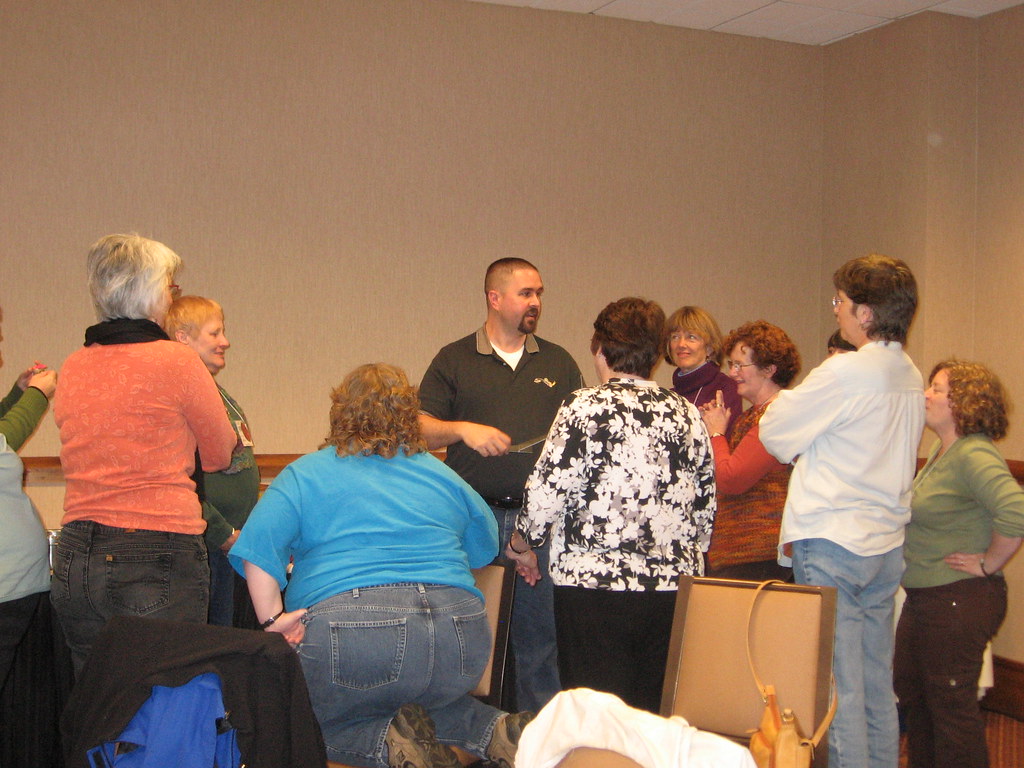


First off, let me tell you how bad his room smelled.  After a week of cooking silk cocoons, it was definitely pungent!  :)  Columbia Sportswear was coming into the resort as we were leaving and setting up a runway in Michael's room.  They must have wondered what in the world those crazy spinners were doing! 


Michael taught us how to reel silk first.  He had been simmering the silk cocoons for about an hour or so until all of them were softened up.  We used a scrubby brush like the kind you use on really stubborn dishes to find the ends of the silk cocoons.  Basically we pummeled the tops of the cocoons and then pulled the brush up.  All of these really fine strands were hanging on to the end of the brush.  We then threaded those filaments on to the silk reeler and were able to start reeling silk. 


Michael had us do 50-70 arm lengths of silk.  He warned us that it wouldn't seem like much but, once we started adding twist to it, we would feel like the silk went on forever.  Let me tell you how true that was! 


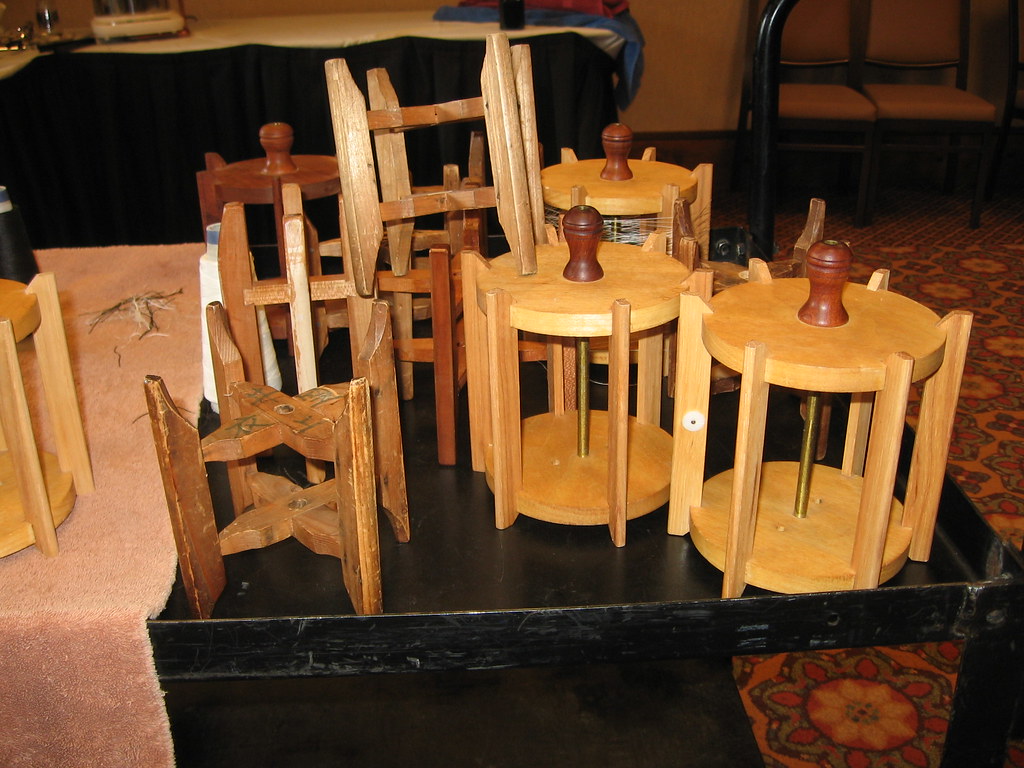
After our 50-70 arm lengths were measured out, everyone wrapped their silk onto these bobbins (or were they spools?) that Michael had brought.  They are very similar to the traditional Chinese tools used for this purpose.  They help the silk not tangle as you are spinning it and helps it dry. 


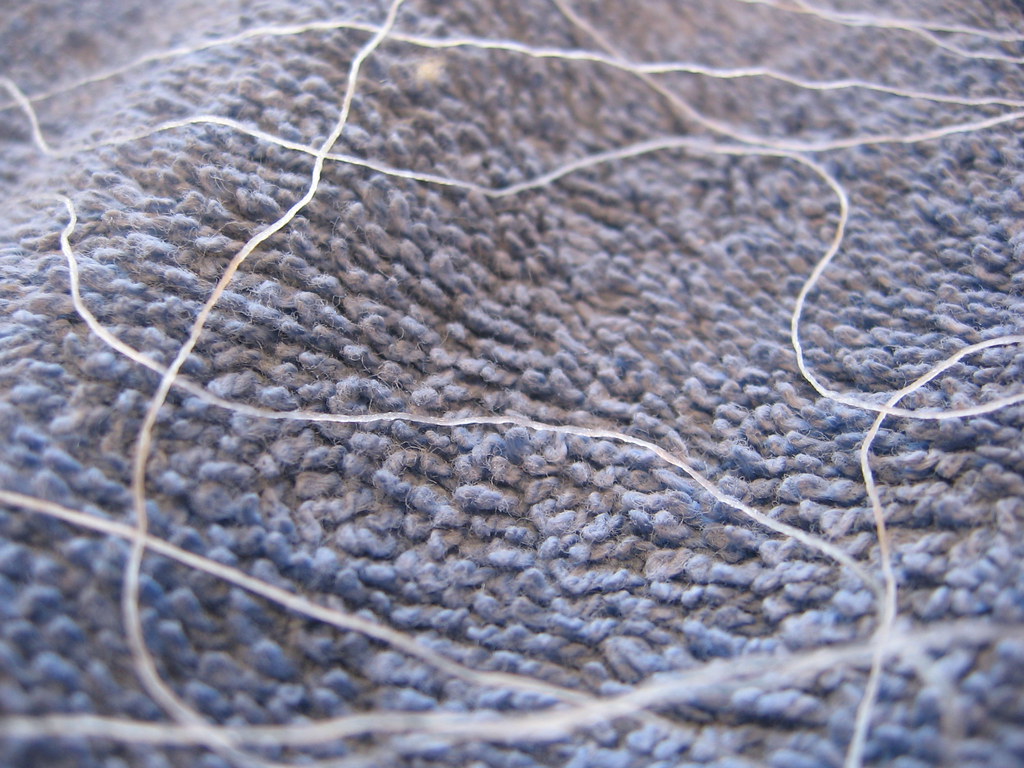
Then we raced to spin up some of our silk.  Why was it a race?  Because we had to put our silk in a degumming bath for 45 minutes in order for it to turn into really nice silk.  We were coming up to the 45 minute mark so everyone's spindles or wheels were flying!  My partner and I both got a good amount spun up but we still had more on our spools.  We both decided to have before and after degumming samples just because we knew we couldn't get everything finished and still make the 45 minute cut-off.  The differences between the two samples are amazing!  The before is stiff, wirey and yellow-ish.  The after, however, is a blinding white that is super soft and silkly (duh, it is silky, right?).  I'm kind of glad that I have both samples to show people. 


What did we do for the next 45 minutes you might ask.  Well, we learned how to make silk hankies.  Silk hankies are layers of silk cocoons stretched out over frames to make them into squares.  If you want to play with silk, I would highly recommend making hankies.  I actually taught our spinning guild how to do this at our next meeting.  Thankfully, where we meet has a sink and stove so it was very easy.  Anyway, back to making hankies at SOAR. 
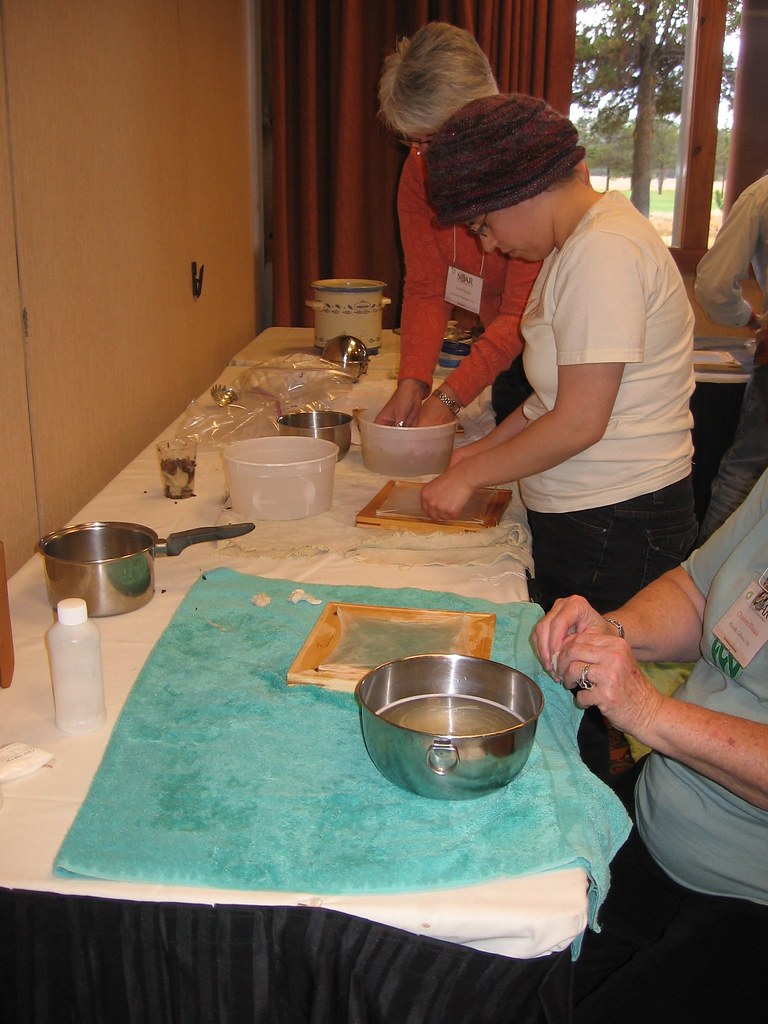


Go to Michael's website and he has a very good photo tutorial about the process.  First, you simmer the cocoons in a degumming solution to loosen them up.  Then you tease one of the ends open and dump out the silk worm and its poo (it's a glamorous project, let me tell you).   Next, you dunk the cocoon in a bowl (or cup) of water and work it between your fingers.  It is almost like a white egg yolk will come off of the cocoon.  Once you no longer have the white yolk coming off, you start stretching the cocoon like a pizza crust.  It will amaze you how far it can stretch.  Michael had us stretch between 5 and 10 cocoons onto square frames.  After we were finished stretching, we rinsed them in clear water then an acidic rinse (water and vinegar).  In class at SOAR, we followed that up with a fabric softener rinse to make it easier to spin the silk later so it wouldn't catch as much on your hands.  Michael recommend that you skip that step if you wanted to dye the hankie latter.  In my mini-workshop at my spinning group, I didn't have them do the fabric softener because a) they might want to dye them later and b) my family doesn't use fabric softener so I would have had to buy some.  After you are finished with the rinsing, you take the hankies off of the frame and squeeze out the water.  It was so much fun!  I'm really happy that I took Michael's class because I learned so much. 

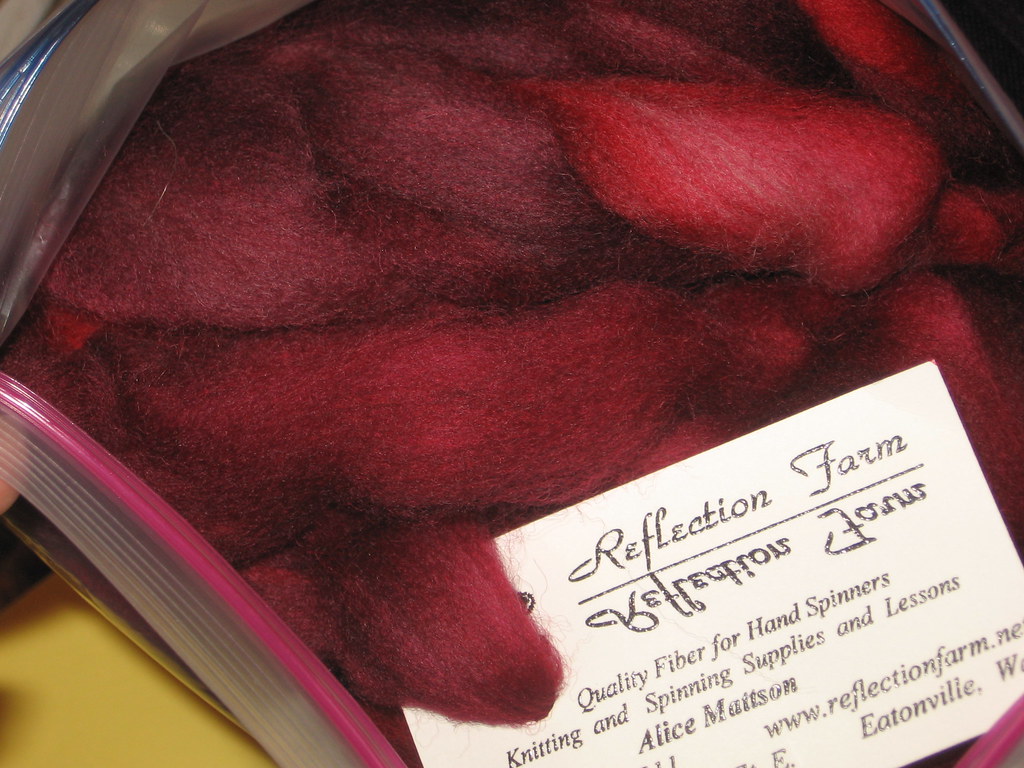
After things were finished in class and we got our newly degummed silk skeins, my partner and I headed back to the marketplace (I know, I know, how many trips was that?).  But it was my last chance of the weekend!  Anyway, I still wanted to pick some things while I didn't have to pay for shipping.  I bought 12 weaving bobbins that I could use for plying.  I've already put a number of them to use so they've been really helpful.  I also broke down and got some more fiber.  It is a fantastic wool (why can't I find my notes about sheep breed?) that reminds me of mixed berries.  It's totally outside of my color range but I love it! 


I also broke down and bought a Turkish spindle from Carolina Homespun.  I've never used a Turkish spindle so I was really interested in learning how to use it.  More about that later. 

After leaving the marketplace for the last time, I ran back to the room to change into my costume, a giant Reese's package.  We all went to dinner and then hung around for the spin-in.  The spin-in was a little surreal.  They had a karaoke machine but the guys who were running it seemed to think all of us would like big band era music.  I guess they thought spinners would be a whole bunch of grandmas.  Hardly anyone got up to sing until the alcohol started flowing.  Then the music being sung was much better.  My group and I moved into the lobby area where it was a little quieter and we could have a chance to visit.  

I wish I had taken pictures of some people's costumes.  My favorite was Denny's because she was dressed as a torch bearer for the Winter Olympics.  She had a Toronto Olympics shirt on and was holding a spindle with some fire-y fiber attached to the top.  It was fabulous!  You could tell where she was in the building by the random bursts of the Olympic theme. 

I crashed around 11pm and went back to the room, not quite ready for the next day when everyone would go home. 

Saturday, July 21, 2007

Harry Potter

OK, the first part of this post is going to be about standing in line to get Harry Potter. The last part is going to be a spoiler marked by **************SPOILER************** a number of rows before the text of the spoiler itself so you can close the window if you haven't finished the book. For those of you who could care less, you can close the window whenever you like :)

So last night Cortni, Meagan, Stephanie, Carrie and I went to stand in line for the book at the Waterstones in Piccadilly Circus. (Waterstones was having the 1/2 off price deal for pre-ordering.) Stephanie and Carrie were just being nice by waiting with the rest of us because they had pre-ordered their copy at another store in Trafalger Square. In hindsight, I wish that the rest of us had ordered from a smaller store, too. The line would have been shorter :) Though the crowd's excitement and all of the activity were exhilerating! Some of the costumes were really fabulous. One girl was dressed up as a stitch with her boyfriend dressed as a broom (though later she we saw her with a Harry Potter, oooooo drama). I also saw an entire family dressed as the Malfoys. Their costumes were really good but I ask you, the Malfoys?

All of the excitement really built as midnight got closer and closer. Finally the time came and the 1/2 to 3/4 mile line errupted into cheers. After that, it was kind of anti-climatic because they were letting only so many people into the store at a time. This made complete sense because it would have been a mad house if they didn't. (It probably was a madhouse anyway.) After an hour, we had only moved one city block and it didn't look like we were going to be going anywhere anytime soon. So my friends and I decided to walk home and come back in the morning to get our copies.

I had no trouble picking mine up this morning and started reading on the tube going back home. I originally planned to read in a park but it started raining again so that idea was out. Erika (who was reading Jane Eyre, not HP), Meagan and I sat in the kitchen all day reading. It was kind of funny because occasionally someone would gasp or laugh or exclaim about what they were reading. If it was Meagan or me, we'd shush each other so nothing would be given away. Towards the end of the book, I had to leave the kitchen so I wouldn't give anything away to Meagan. I think she would have hit me with the book and you know the size of that sucker . . . :)


**************SPOILER************** kind of


OK, I'm not going to dissect the book tonight because now I am coming off my high from finishing the book and am getting very tired.

J.K. Rowling is a wonderful author. She grabs your attention from the very first page and keeps it until the end. I was amazed by the ways she developed her characters and really kept you guessing about some of their motives until the very end. You know the one I am talking about.

How about that pensive memory of Snape's? Most of the time before this book was released, I was torn about whether or not he was good. I finally decided that he killed Dumbledore in order to ensure that Draco didn't but couldn't decide if he had truely betrayed Dumbledore to Voldemort. I found the conversation between him and Dumbledore about Dumbledore's death very powerful. Imagine planning out your own death. That was asking a lot of Snape to do. Sure, Dumbledore was dying already but Snape still had to kill him.

Didn't your heart just sink when Dumbledore told Snape that part of Voldemort's soul was put into Harry when he was a baby and Voldemort tried to kill him? That meant that Harry was a Horcrux. One of the very things that Harry was trying to destroy and needed to be destroyed before Voldemort would finally die. At that point, I knew Harry would sacrifice himself in order to make sure Voldemort would be stopped. I never even considered that he was doing the exact same thing that his mother did, ensuring that everyone fighting Voldemort had the protection of love. Now it makes perfect sense! I guess I was distracted by the drama of the fighting and the horrible losses of Fred Weasley, Remus Lupin and Dora Tonks.

The moment that Harry faced the Killing Curse for a second time was horrible. I hoped that she wouldn't kill Harry off but it was so hard to tell what would happen. It was clever the way that Rowling showed that Harry could survive because a part of him (his blood) was in Voldemort like a part of Voldemort's soul was in Harry.

And how about the ending chapter? It made me so happy that she did a follow-up for when the children of all of the main characters were headed to Hogwarts on the train. It would have been horrible to be left hanging at the end of the fighting even though the good side had won.

OK, the last part of this spoiler was a bit disjointed because now I really have to go to bed. Tomorrow, we go on an extremely long train ride to Edinburgh. Yea.

Saturday, June 16, 2007

Miravi

New favourite word, miravi. It is Latin for "I was amazed!" I just finished reading Route 66 A.D., a nonfiction travel book which is the story about ancient Roman tourists and a modern tourist's attempt to recreate their travels. I would highly recommend it for anyone who likes Roman history or information about the Mediterranean. I think miravi would be a good name for a sock pattern. Hmmm. . . .

Speaking of socks: I'm about 2 inches away from being done with the socks I started last Saturday. I accidentally left the memory card in my computer so no pictures for you :( The bamboo yarn feels great and I've been told that it feels even softer after washing. Probably going to be going to the Needling Yarn this afternoon to hang out and finish them.

A friend and I went to Cafe Connections in Newark yesterday. It was so much fun! Definitely not the sort of place you expect in a strip mall. It was a combination coffee shop, wine bar, and restaurant/cafe. I had Chicken Fettuccine and my friend had a salad (which was huge!), both had wine and shared a Key Lime Torte. I like the feel of the place and will definitely have to go back. They have painted it with very bold colors and have a crazy, fun mix of tables from a dining room table to tall, outdoor sort of tables. Very eclectic and funky.

I'm thinking about going to Gahanna's Creekside Blues and Jazz Festival tomorrow. They shut down the main streets in Olde Gahanna (is anyone else highly amused when places put the extra "e" at the end of things?) and have music and food. Ooooo, I would be able to get Rita's, too (be warned, that site plays very loud music). I really like the little park next to the creek there.

Monday, May 14, 2007

World War Z

Here's another book review for you.

Max Brooks' World War Z: An Oral History of the Zombie War is an astounding book and I don't like zombie films/stories (well, except for Shaun of the Dead and that is because it is a spoof). After reading this book, I definitely understand why people are calling it one of the best new fiction books of 2006.

Brooks has masterfully created a story though personal accounts of survivors about the spread of the zombie virus and how the world fought back against the living dead. The plague or virus seems to have started in China and spread quickly across the world. Some areas were better prepared than others to defend themselves from the zombies while others were woefully unprepared. New York, for instance, wasn't able to defend itself but Buckingham Palace held its own for many months before it was rescued. At first, the war is a defensive one but then the survivors must go on the offensive to re-claim the Earth.

Brooks writes the story as if the reader already knows what happened during the war. This story is supposed to have been written 12 years after the end of the war with the world still recovering from its ordeal. We are left to discover the details as he interviews the survivors. Each of the stories are woven together, pulling the reader further and further into the events. The book makes you wonder what you would do in these people's situations.

I cannot possibily express how much I am impressed by this book and author. His imagination is amazing. He created a story which could be believable (well, except for the whole dead coming back to life thing) and whose characters are interesting and well-drawn.

Tuesday, February 06, 2007

The Professor and the Madman

I finished reading the historical non fiction book/micro-history,The Professor and the Madman: A Tale of Murder, Insanity, and the Making of the Oxford English Dictionary by Simon Winchester. I really liked it. Our library system had a non fiction book club read it a couple of months ago.

A historical non-fiction is a book that reads almost like fiction. A micro-history is a book which focuses on one small part of history. The part can either be an item or a time period. Seabiscuit is a wonderful example. It focused on horse racing during the Depression and really made that time-period come alive.

The Professor and the Madman focused on two men who were strongly involved in the editing of the OED: James Murray (the professor) and Dr. William Chester Minor (the madman). The vast undertaking of creating the OED simply amazed me. Before 1857 (when the idea was first suggested), there was no all-encompassing English dictionary. Or at least, not a dictionary like we think of today. The OED editors set out to catalog, define, provide illustrative quotations, and track the word's history through written history from its first use until the current day. Every. Single. Word. Wow.

They had thousands of volunteers read through books, write down words (any words), illustrative quotations, where the quotation was found, page number, and send in the slip of paper to the Scriptorium that Murray had set up in Oxford. The Scriptorium might sound impressive but really it was just a corrugated metal structure full of paper. Can you even imagine the scraps of paper everywhere? How would anything ever get done or even found?

Dr. Minor is introduced as a madman from the very beginning of the book. A madman but also an intellectual. He was an American doctor who served in the Civil War. Apparently, his paranoia was sparked and/or became more pronounced after an experience during the Wilderness where he had to brand an Irish soldier as punishment for desertion. After that, he felt that the Irish everywhere were after him in revenge. He also complained of being followed and being forced to perform "lewd acts" every night by persons unknown. A while after the end of the war, Minor left America for England. He was imprisoned in Broadmore, a lunatic asylum there, when he murdered a man in London. (Minor thought the man was going to attack him.)

While in Broadmore, Minor had an extraordinary amount of special privileges. He had a pention from the U.S. Army and was a doctor like those taking care of him so Minor was housed in the nice part of Broadmore. He had the use of two rooms, one of which served as a library and the other which was his bedroom, where he painted and played his flute. The library was quite impressive because he collected rare works and anything else that caught his interest. Minor hired one of the other inmates to clean his rooms and perform small tasks. Sounds pretty nice, huh? He still had the slight problem of thinking people were breaking into his room at night and poisoning him or forcing him to perform those lewd acts.

Ten years after he was first imprisoned, Minor came across Murray's plea for volunteer readers. He wrote to Murray offering his services and got down to reading. Minor's approach to the task was completely different than that of the other volunteers. He would read a book through writing down each word that caught his attention and page number where it was found. He wrote the words down so that they would be in alphabetical order, leaving space for words he would find as he read. Once he finished one book, Minor would go on to the next. Because he wasn't sending in submissions to the editors in Oxford, they thought he had gotten bored with the project.

Once Minor thought he had come up with enough words, he wrote to Murray asking him if they were having any difficulty with any word. When Murray responded that "art" was vexing them, Minor immediately responded with quotation, volume number, and page number. After that, Murray and his workers would send any word "problems" to Minor and he would immediately respond with a correct response. Because Minor had his word lists minutely indexed, it took him no time at all to find a correct quotation. As the author says, other volunteers might have sent in more quotations but Minor's were worth their weight in gold. The editors knew they didn't need to double-check his work.

It was very interesting to watch the friendship between Minor and Murray develop. They corresponded for years and Murray visited Minor frequently in Broadmore. I also found it fascinating to learn more about the editing of the massive dictionary.

The only problem I had with the book was that the author, Simon Winchester, did not have a bibliography in the back of the book. True, he mentioned other books people could read to learn more and talked about some of the books he read. But, to a historian like me, that is not good enough. I want to see all of the documents he used. The letters, the journals, the books, the interviews. Everything. Still, I greatly enjoyed the work and would highly recommend it.